

A recent trip to Florida was intended primarily as an opportunity to step away from the demands of daily life and recharge. While I spent time reading, resting, and deliberately disconnecting from routine obligations, I also continued building one of the foundational components of the Vectors to Final framework: an expanding photographic reference library.
Photography plays an important role within my creative process. While the final works are not traditional photographs themselves, photography often serves as a critical element. It allows me to capture details, structures, textures, and relationships that are integrated into the greater composition. During this trip, I was specifically searching for source material for future works. In the process, I found myself drawn to a series of aircraft details that stood on their own as compelling visual subjects.
The resulting images came from three very different aircraft: the North American B-25 Mitchell, the Grumman F8F Bearcat, and the Grumman F9F-6 Cougar. Although separated by era, mission, and technology, each revealed something that aligns closely with one of the central themes of the Vectors to Final concept: the relationship between organic and geometric form.
The Aircraft Beyond the Aircraft
Most people view an aircraft as a single object. Pilots, engineers, mechanics, and photographers often see something different. An aircraft is not simply a machine. It is a collection of systems, structures, surfaces, and relationships. Viewed closely, recognizable forms begin to dissolve into something more abstract. Curves intersect straight lines. Rivet patterns become repeating grids. Reflections distort geometry. Light transforms functional structures into compositions of shape and texture.
The closer one looks, the less the subject becomes an airplane and the more it becomes an arrangement of visual information. It is precisely this transition that interests me. Within the Vectors to Final framework, the tension between organic and engineered forms frequently serves as a foundation for image construction. These aircraft naturally embody that relationship. Their design is intensely mathematical and deliberate, yet weathering, age, light, and environmental exposure introduce qualities that are entirely organic.
The result is a visual language containing both precision and unpredictability.
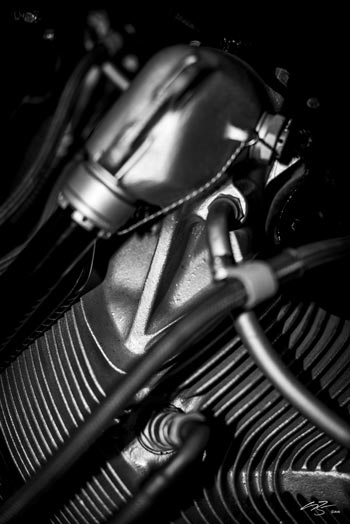
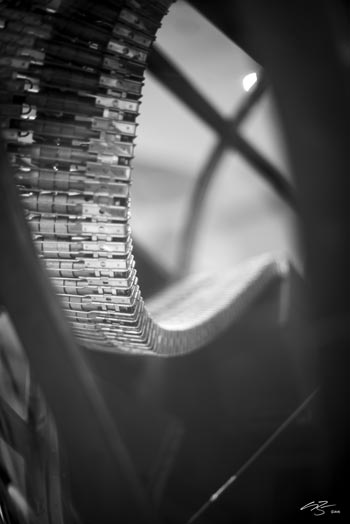

The F8F Bearcat: Refining the Piston Fighter
The Grumman F8F Bearcat represents the final evolution of American piston-engine fighter development during the Second World War. Designed late in the conflict as a successor to the F6F Hellcat, the Bearcat became known for exceptional climb performance, maneuverability, and power. The aircraft embodied decades of rapidly advancing aeronautical engineering and represented one of the most refined carrier-based fighters of the piston era.
What interests me photographically is not simply its historical significance but the visual character of its surfaces. The Bearcat combines muscular curves with highly intentional engineering. Cowling panels, access doors, cooling openings, and riveted structures create relationships between smooth aerodynamic forms and rigid geometric systems.
Examined closely, the aircraft becomes a study in contrast. Every line exists because it serves a purpose. Yet the accumulation of those practical decisions produces something unexpectedly elegant.
The F9F-6 Cougar: The Geometry of Transition
The F9F-6 Cougar occupies an important place in aviation history as the U.S. Navy’s first swept-wing carrier-based fighter jet. Developed from the straight-wing F9F Panther, the Cougar emerged as American engineers responded to dramatic advances in jet performance during the Korean War era. The introduction of swept wings fundamentally altered both the appearance and performance characteristics of military aircraft.
Photographically, the Cougar presents a different visual experience than the Bearcat. The piston-era aircraft relies heavily on curves and volumetric forms. The Cougar introduces sharper directional movement. Swept wings, elongated intake geometry, and streamlined fuselage contours create compositions that guide the eye across the image with remarkable efficiency.
Many of the photographs created from the Cougar focus less on the aircraft as a complete object and more on the directional systems embedded within its design. Angles intersect. Shadows create secondary geometry. Structural transitions generate rhythms that feel almost architectural.
In these moments, aviation design begins to resemble abstract composition.
The B-25 Mitchell: Structure Made Visible
Few aircraft are more iconic than the North American B-25 Mitchell. Best known for its role in the Doolittle Raid and its extensive service throughout the Second World War, the Mitchell operated in every major theater of the conflict and was adapted for numerous specialized roles. More than 9,800 Mitchells were produced during the war.
Unlike the fluid forms of single-seat fighters, the B-25 reveals its structure more openly.
Large access panels, heavily riveted surfaces, glazing systems, and modular construction create a visual complexity that rewards close observation. The aircraft is filled with repeating patterns that were never intended to be artistic but become visually compelling nonetheless.
Rows of fasteners become linear compositions. Reflected light reveals subtle curvature. Panel intersections create grid-like relationships across surfaces designed for entirely practical reasons.
The resulting images often feel less like photographs of an airplane and more like studies in industrial geometry.
Light, Pattern, Texture, and Form
What connects these aircraft is not their mission or their historical era, rather it is the vocabulary they provide. Light reveals structure. Pattern creates rhythm. Texture records time. Form establishes hierarchy. These elements are central to photography, but they are equally important within the broader Vectors to Final process. Many of the visual decisions that appear in my larger works begin with observations made in moments like these.
The photographs are not necessarily destinations. Often they are points of departure. Yet occasionally an image exists comfortably on its own. These aircraft details became that kind of image.
Looking Beyond Function
One of the most interesting aspects of aviation is that nearly everything visible on an aircraft exists for a reason. Every panel, fastener, opening, fairing, and surface serves a functional purpose. Yet when viewed through a different lens, those same features transcend function. They become studies of balance, structure, alignment, and visual tension.
In many ways, that is the same process that exists at the heart of Vectors to Final: discovering beauty not through decoration, but through clarity. Not through invention, but through observation. Not through removing complexity, but through finding order within it. The B-25 Mitchell, F8F Bearcat, and F9F-6 Cougar were all designed as machines. What interested me during this trip was how naturally they became something else entirely.
This reflection exists alongside a broader visual practice shaped by responsibility, presence, and disciplined decision‑making. To see how these values take form across my aviation‑informed work, explore the full practice here.
