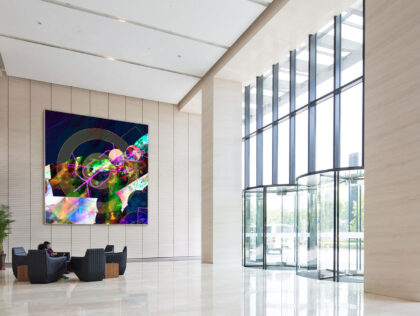
Recognition, familiarity, and layered understanding
When these works are installed in aviation environments, something interesting happens. Pilots often engage with them differently. Rather than scanning passively, they trace relationships, notice alignments, and follow patterns that feel familiar—even if they can’t immediately explain why.
This response is not accidental, nor is it exclusive.
The work is built from systems that pilots already operate within—structures that prioritize orientation, proportional thinking, and relational awareness. As a result, recognition can be immediate for those who live inside these frameworks daily.
For others, the experience unfolds differently.
Recognition Is Not a Requirement
The work does not depend on aviation knowledge to function, nor does it conceal meaning behind specialized symbols or coded references. Instead, it offers layered accessibility.
Some viewers respond first to balance, color, and restraint, while others sense tension, movement, or containment. Pilots, in contrast, may recognize structural logic that echoes familiar systems.
No single reading completes the work.
Familiarity Changes the Entry Point
Expertise doesn’t unlock hidden content—it shifts where the viewer enters.
Pilots often begin with structure, while non-aviators begin with form. However, both paths lead to the same place: a composition governed by internal consistency.
The work does not reward knowledge—it accommodates it.
Why the Systems Remain Unnamed
Naming specific references would collapse discovery into instruction. Once a system is labeled, the experience narrows, and the viewer shifts from observing to confirming.
By leaving the structure intact but unnamed, the work preserves openness. In this way, recognition becomes personal rather than prescribed, and discovery belongs to the viewer rather than the artist.
Shared Space, Distinct Experiences
What matters most is that the work holds under multiple readings. It does not change for different audiences. Instead, it remains stable whether its systems are recognized, felt intuitively, or simply experienced visually.
The difference lies not in the work itself, but in how viewers relate to it.
In Closing
When pilots find familiar logic within the work, they are not discovering a hidden message—they are recognizing a way of thinking. Others may never notice those relationships, and nothing is lost.
The work does not ask who the viewer is.
It asks only for attention.
This article reflects themes that recur throughout my aviation‑informed visual practice, where structure, precision, and non‑literal systems shape the work at an institutional scale. An overview of this approach can be found here.