Learning To See
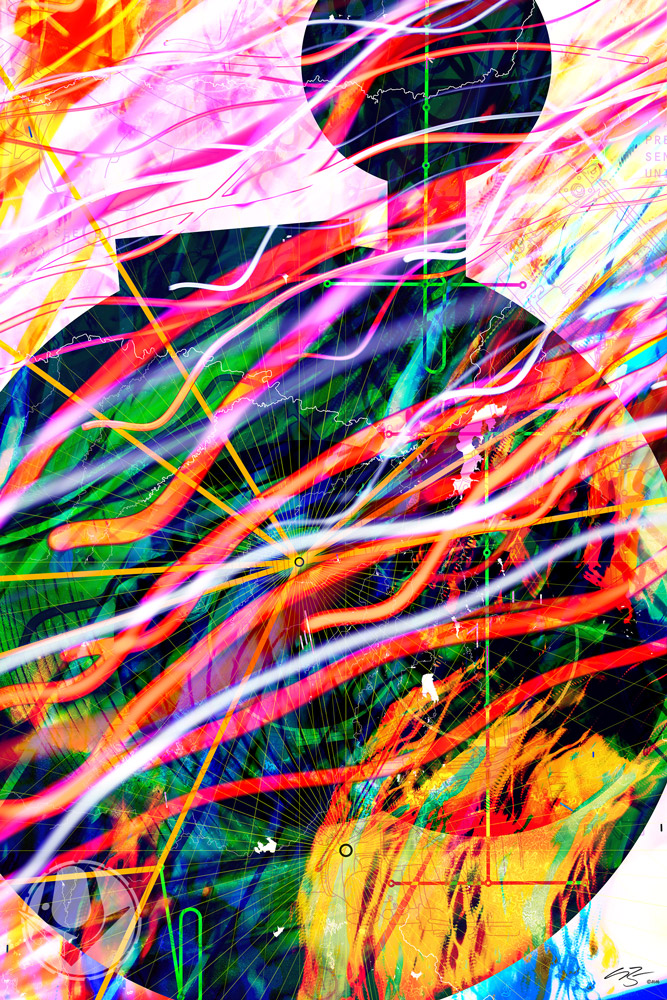
In the first part of this series, I wrote about the difference between looking and seeing. We all look at the world, but experience changes what we actually notice. The longer I thought about that idea, the more I realized that my artwork is built around it. A piece may appear relatively simple when viewed from a distance. A few shapes. Lines. Color. Space. But simplicity on the surface doesn’t necessarily mean simplicity underneath.
The Sky Has No Roads
One of the reasons aviation has influenced the way I think visually is that flying requires you to understand relationships that aren’t always visible. When you’re driving, the world provides an enormous amount of information for you. Roads tell you where to go. Signs tell you where you are. Traffic signals tell you when to stop. Buildings and landmarks provide constant visual references.
The sky doesn’t work that way. There are no painted lanes stretching across the atmosphere. No road signs hanging between clouds. No obvious line showing you exactly where one area ends and another begins. Yet aviation is governed by an enormous amount of structure. There are routes, headings, altitudes, airspace boundaries, procedures, weather information, navigation systems, communication, and contingencies. The apparent simplicity of an airplane moving through the sky is supported by an extraordinary amount of invisible organization. Once you’ve spent enough time around aviation, you begin to see that structure even when it isn’t physically visible. That has changed the way I look at other things.
Structure Doesn’t Have to Announce Itself
I think we often associate structure with something obvious. A building has structure, a spreadsheet has structure, a blueprint has structure, but visual structure can be much quieter. It can exist in the distance between two elements, the weight of one shape against another, the direction in which the eye travels, or the amount of empty space surrounding an object. Those relationships are easy to overlook because nothing is necessarily calling attention to them. They’re simply there. That is much of what interests me about composition. I don’t want every decision to announce itself.
The Things We Learn to Notice
Photography has taught me to look closely at things that most people would probably walk past such as a piece of an aircraft, a reflection, a pattern, a surface or a shadow. Taken literally, these things may be unremarkable, but when you isolate them, something changes. Shape becomes more important. Texture becomes visible. Relationships become clearer. This is one reason photography became such an important part of my creative process. The camera isn’t always the final destination. Sometimes it is simply an instrument for learning what is there.
Seeing Is an Accumulation
None of these ways of seeing developed independently. My background in fine art taught me to observe. Graphic design taught me to organize. Photography taught me to isolate. Aviation taught me to understand systems and relationships. Years of creative work taught me to make decisions. Those experiences accumulate. Eventually, they become difficult to separate. When I begin working on a piece, I don’t consciously stop and say, “Now I will use what I learned in photography, followed by what I learned in aviation.” It doesn’t work that way. Those experiences have become part of how I see.
Why I Don’t Explain Everything
There is another reason I prefer not to explain every reference contained in my work. Discovery is part of the experience. If I tell you exactly what every shape means before you look at the piece, I’ve done some of the seeing for you. I’d rather give you enough to become curious. Then you can look. You may notice something I intended. You may notice something I never considered. You may see a relationship based on your own experiences that has nothing to do with aviation. That’s okay.
In fact, I want you to do just that.
Art doesn’t require that the artist and viewer arrive at exactly the same destination. Sometimes the more interesting experience is discovering how they arrived somewhere different.
Looking Again
This is why I often encourage people to spend a little more time with a piece. Not because there is a correct answer waiting for them. There isn’t. It is because the first thing we notice is rarely the only thing there. The first glance identifies objects. The second begins to notice relationships. Sometimes, if we stay long enough, we stop looking at the individual elements altogether and begin experiencing the composition as a whole.
That transition—from identifying things to understanding relationships—is one of the things that interests me most about making art, and it leads naturally to another question. If an artist can create something that doesn’t depict a recognizable object, doesn’t follow traditional expectations, and still communicates something through structure and intention…
What exactly makes something art?
That’s where we’re going next.