What Do You See?
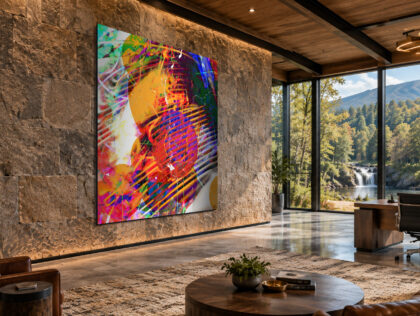
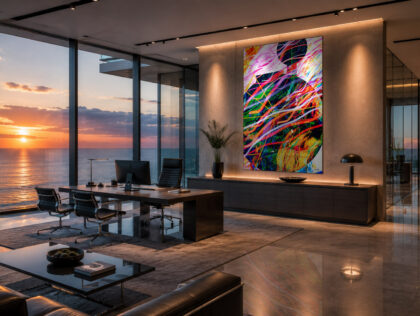
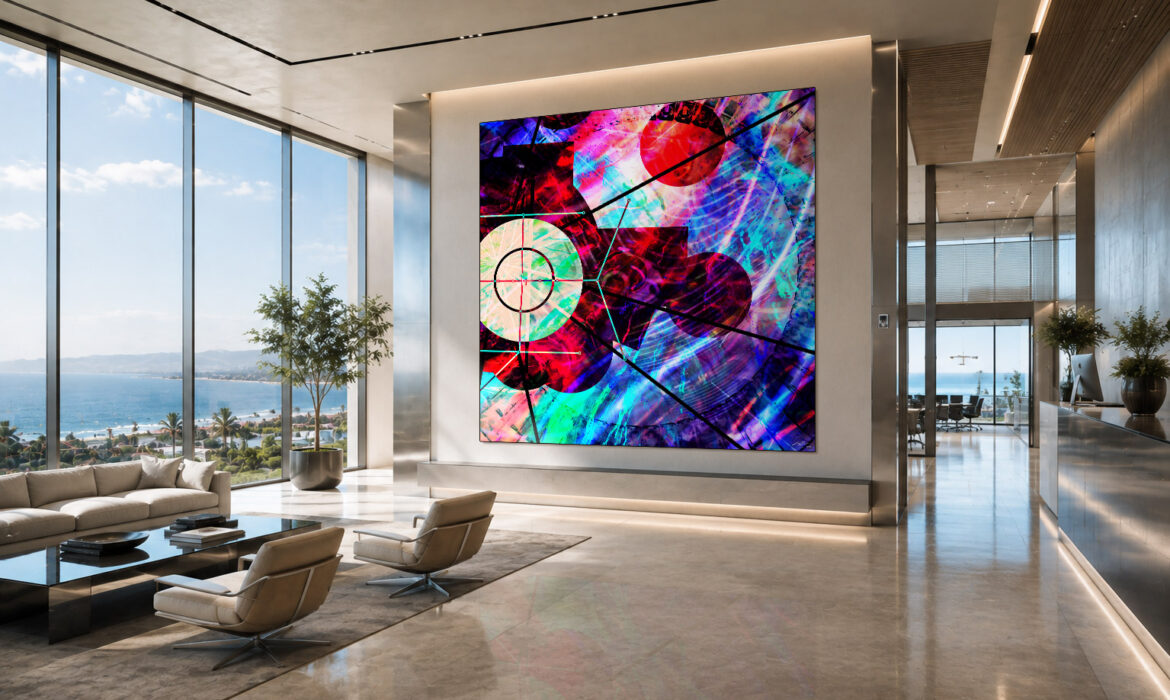
What do you see when you look at a piece of artwork? More specifically, what do you see when you look at one of mine? Some people see circles. Others see lines, shapes, colors, or patterns. Occasionally, someone will look at a piece and say, “My kid could do that.” And, in the most literal sense, they may be right. A child can certainly draw a circle. The circle is there. The lines are there. The colors are there. But those things are not necessarily what the artist sees.
I’ve always been interested in the difference between looking at something and actually seeing it. The distinction is something I think about often because I experience a similar difference when I listen to music.
Hearing More Than a Song
When most people listen to a song, they hear the melody, the lyrics, the singer, and the overall sound. I don’t necessarily hear music that way. I might know the lyric “Money for nothing, chicks for free,” thanks to Mark Knopfler, but I couldn’t tell you the lyrics to a song I’ve heard a thousand times. My brain tends to focus somewhere else.
I hear structure.
I can hear when a key changes. I can sometimes isolate individual instruments and follow their voices separately while also hearing how they interact with one another. I may not understand the precise musical reasoning behind why John Williams chose B-flat major for the main theme of Star Wars or G-minor for the Imperial March in The Empire Strikes Back, but I can hear what the change in key does to the character of the music.
If you played E Phrygian for me, there’s a good chance my brain would immediately transport me to a golden sunset somewhere in Seville, Spain watching a dancer with a rose stem in her teeth.
That’s simply how I hear music. It isn’t necessarily a better way of listening. It’s just what years of listening have taught me to notice. The same thing happens when I look at art.
Experience Changes What We Notice
A photographer sees light differently from someone taking a snapshot with a phone. Everyone can see whether a day is sunny or cloudy, but a photographer may notice the direction of the light, the contrast, reflections, shadows, and the way changing light transforms the appearance of an otherwise ordinary subject.
A pilot sees the sky differently from a passenger. A passenger may see clouds, mountains, or an interesting view outside the window. A pilot sees atmospheric conditions, terrain, airspace, altitude, traffic, fuel considerations, and a constantly changing set of decisions. The sky isn’t simply scenery. It is information. An architect sees structure. A designer sees hierarchy. An engineer sees systems. A musician hears relationships. An artist sees relationships, too.
This is one reason two people can stand in front of the same piece of art and have completely different experiences. One person may see circles while another sees tension. One sees color while another sees movement. One sees individual shapes while another sees the relationships between them. Neither person is necessarily wrong. They are simply noticing different things.
Experience changes what we notice.
The longer we spend immersed in a discipline, the more we begin to recognize patterns and relationships that may have been invisible to us before. Eventually, those observations become so natural that we may forget we had to learn how to see them in the first place.
The Strange Part About Expertise
There is something interesting about becoming good at something – eventually, you stop noticing how much you have learned. Once something becomes obvious to you, it can be difficult to remember a time when it wasn’t obvious. That happens in almost every profession. A carpenter looks at a piece of lumber and sees possibilities that someone else may not recognize. A musician hears relationships within a chord progression. A chef recognizes combinations of flavors and textures that another person might never consciously identify.
A pilot can recognize a developing situation before it becomes an obvious problem. And an artist can see relationships within an image that may not be apparent to someone seeing it for the first time. Years of experience quietly alter perception. Perhaps that is one of the simplest ways to describe mastery – not simply knowing more, but learning where to direct your attention.
What I See in My Own Work
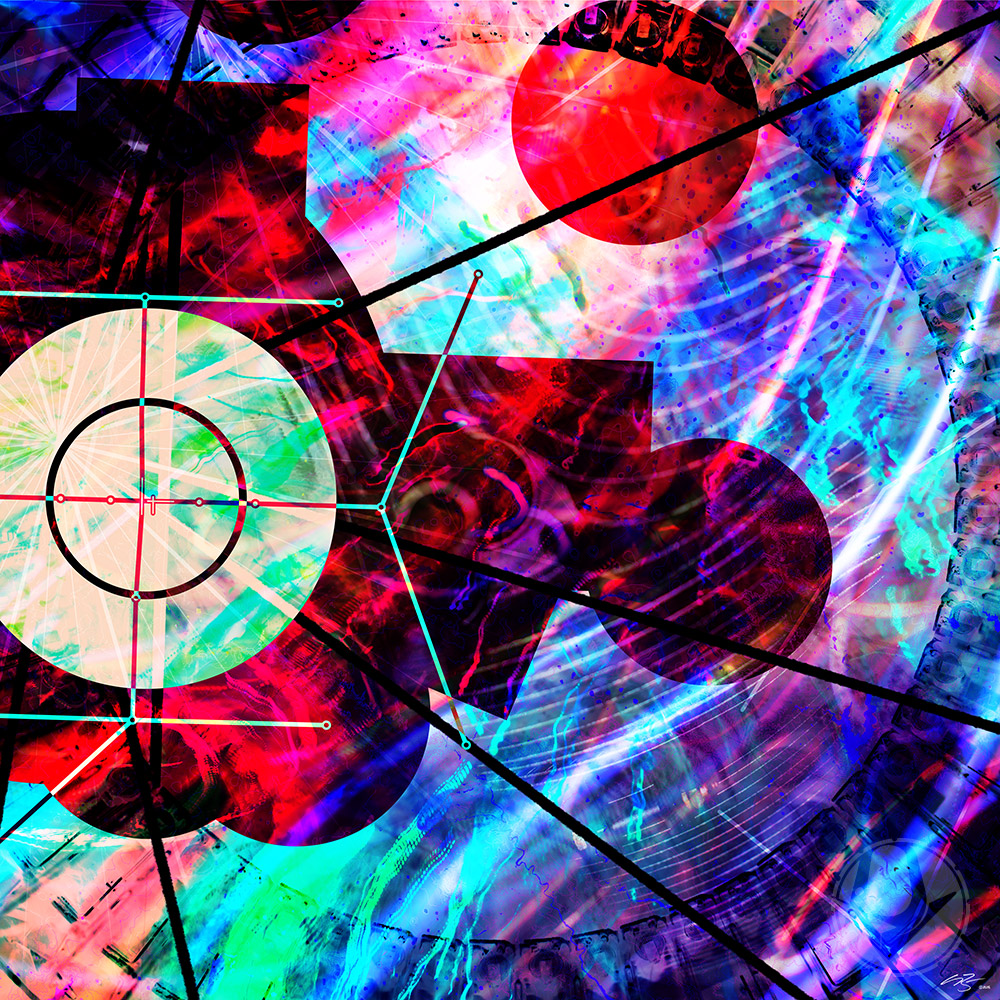
When I look at one of the pieces in my collection, I don’t simply see a collection of geometric shapes. I see relationships and boundaries. I see where one element ends and another begins. I see an origin point, and that origin has meaning because it establishes a specific location. When there are two or more shapes, I see the relationship between one point and another. In many ways, that is the essence of aviation itself. It is moving from one point to another.
As an aviator, I naturally look for structure. Every element occupies a particular place, and its position can affect what happens around it. What can happen here that cannot happen there? What separates these spaces? How do they interact? Those same questions find their way into my artwork.
Compositionally, I see balance, visual weight, movement, and density. Some elements draw the eye immediately while others create quieter pathways through the image. Large forms can establish stability while smaller elements introduce energy or tension. Even empty space has a purpose. It gives the eye room to move, pause, and make sense of what it is seeing. A viewer may see a collection of symbols. I see a visual conversation.
There Is More Beneath the Surface
When I build one of these pieces, some decisions are obvious and others are almost invisible. Very little is accidental. The finished image may appear spontaneous or intuitive, but there is a great deal of structure beneath it. Elements are positioned deliberately. Relationships are considered. Visual decisions are made for specific reasons. That is true of the finished artwork, but it is also true of the way I approach seeing in the first place.
My background as an artist, designer, photographer, and aviator has given me several different ways of looking at the same thing. Sometimes those disciplines overlap in ways that are difficult to separate. A photograph teaches me to notice light. Design teaches me to notice hierarchy and composition. Aviation teaches me to notice relationships, position, structure, and systems. Fine art gives me the freedom to bring those observations together in a different way. The result may look simple. The thinking behind it isn’t.
So, What Do You See?
When someone looks at one of my pieces and sees circles, lines, or shapes, I don’t see that as a failure to understand the work. Those things are genuinely there. They are simply the first layer of what is there. What interests me is what happens after that first glance. What happens when you spend another few seconds looking? What relationships begin to emerge? Does your eye follow a particular path? Do certain shapes begin to feel connected? Does the composition start to create movement, tension, balance, or rhythm? Maybe you still see circles. That’s perfectly fine.
The interesting part isn’t whether you eventually see what I see. The interesting part is discovering what you see—and understanding that your answer is shaped by everything you’ve learned to notice throughout your own life. Looking is automatic. Seeing is learned. And once you begin to understand that distinction, you may start noticing that it applies to far more than art. If seeing is learned, a bigger question naturally follows:
What actually makes something art?
We’ll explore that in Part 2.